Goblin
Goblin is a private, mobile-first payments app for Grin. Think Cash App, but the money is Grin, your address is a Nostr key (an npub), and the whole conversation can ride Tor.
You type alice instead of pasting a 90-character key: a username is an optional, friendly alias that the wallet resolves to the real address (the npub) behind the scenes. You tap Pay/Request, hold to confirm, and a Grin payment travels end-to-end encrypted over the Nostr network, so no relay, no network observer, and no chain analyst can tie the sender to the receiver. Turn on Tor routing (on by default for wallets that update; a per-wallet choice for new ones) and your IP is hidden from the relay too.
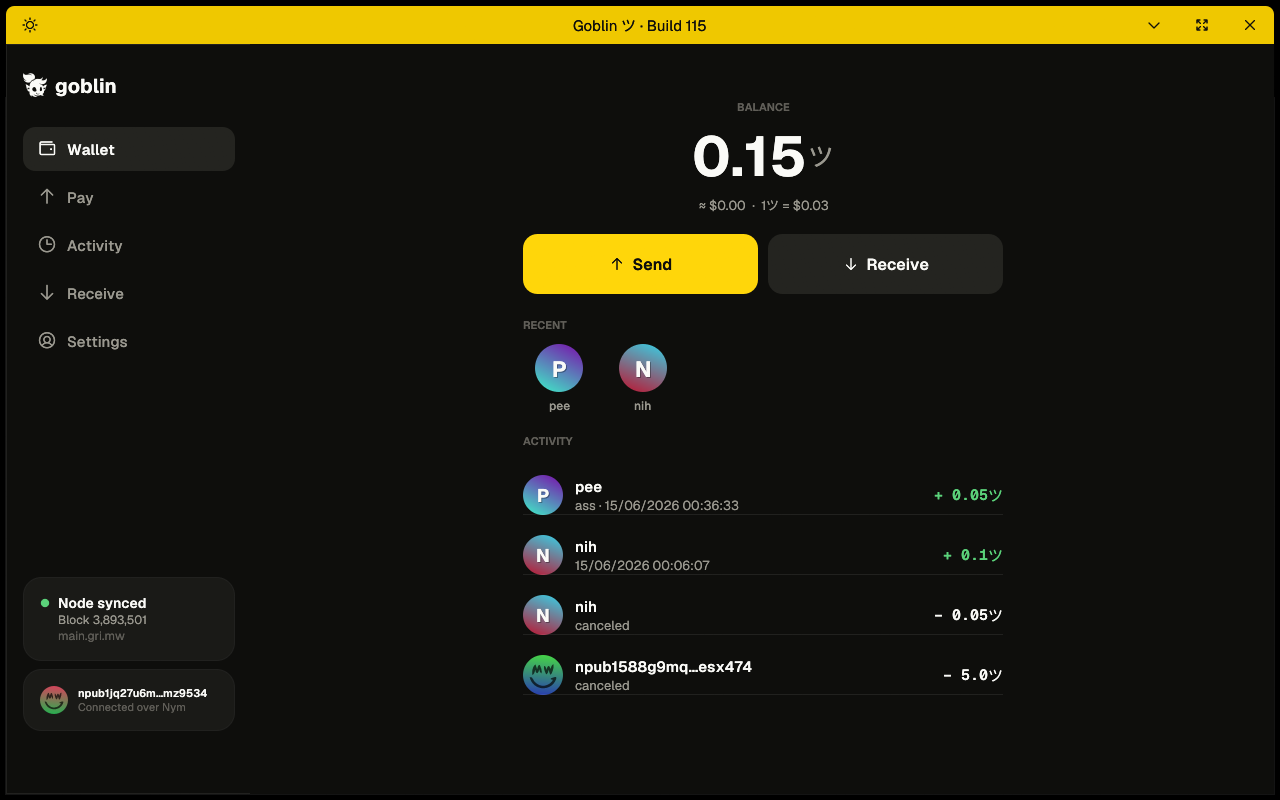
Goblin home, connected over Tor (optional).
Under the hood Goblin stands on three pillars:
| Pillar | What it gives Goblin |
|---|---|
| GRIM | A complete, audited Grin wallet + node engine: seed, sync, and the Mimblewimble slatepack transaction machinery. Goblin forks it and keeps it. |
| Nostr | The messaging layer. Addresses (npub keys) with optional usernames on top, encrypted payment messages (gift-wrapped slatepacks), and offline delivery, all without running our own bespoke server. |
| Tor | The transport, as a per-wallet switch. With Tor routing on, all relay traffic and every HTTP request rides Tor, embedded in-process, out through a Tor exit to each destination’s ordinary clearnet host. The public Grin chain connection is always direct, by design. |
Goblin is also one piece of a larger Grin-native stack: the GoblinPay till, the Magick Market marketplace, and Floonet relays all speak the same wallet-to-wallet payment rail. For a tour of how they fit together, and how to self-host them, see goblin.st/use-cases.
How to read these docs
The docs are organized from the outside in:
- Overview: what Goblin is and how the pieces fit.
- Pillars: the three foundations (GRIM, Nostr, Tor), each broken into its component parts.
- Features: the things you actually do: pay, request, claim a name, onboard.
- Subsystems: the smaller machinery: themes, avatars, QR, localization, security.
- Operating Goblin: run your own name authority and relay; build from source.
Every component page follows the same shape:
Summary: one paragraph, what it is. Motivation: why it exists, the problem it solves. How it works: a plain-language walkthrough, with screenshots. Reference: the technical detail: types, functions, wire formats. References: links into the source (
file:line) and the external standards.
Goblin is open source. Where these docs cite code, they point at the public source tree so you can read along.